Showing posts with label interviews. Show all posts

Saturday, July 15, 2017

The Other Pancho

Published July 2017 in EDible Memphis

Jose “Pancho” Leon is kind of a big deal in Venezuela.

Pancho’s Venezuelan-based company, Catatumbo Flavors, has forty different offerings — from hot sauce to chutney. He’s launching three of his favorite hot sauces locally under the brand “PicaPancho” thanks to the help of Delta Cuisine’s Commercial Kitchen and Food Incubator just across the bridge in West Memphis.

A couple of friends and I were recently invited to join Pancho and his extended family for Sunday dinner at his daughter, Sylvia’s, house in Cordova. Since he doesn’t speak English, Sylvia and her brother, Jose, served as interpreters.

Everyone was busy in the kitchen when we arrived. The grill was fired up and there were mango daiquiris ready to be put in the blender.

Pancho learned to cook from his mother when he was just nine years old, and does all of the cooking for his family. The first thing he remembers cooking is bistek (beef steak) with onions. I’ve known Pancho and his family for awhile now, and no menu is complete without lots and lots of meat!

Jose explains, “The city we grew up in is Maracaibo, the capital of Zulia State — which is basically the Texas of Venezuela. It’s got oil, beef, and pretty women.”

It’s only natural that Pancho, now a graduate of Concasse (The Institute of Culinary Education) which afforded him the title of International Chef, would create a number of sauces to go along with all the meat that he cooks. He loves spicy sauce, and his first creation was a sriracha with yogurt. (Sriracha, which is a town in Thailand and the namesake of the well-known “rooster sauce,” has become synonymous with “hot sauce” around the world.)

For the yogurt, Pancho uses suero de leche, which is translated as buttermilk. Jose says suero is a cousin of yogurt. Since they lived in cow country, Pancho started making his own suero, and from there he created the sriracha with yogurt. Everyone loved it, so he started taking it to friends’ houses.

A most of these stories go, one day his wife, Sylvia, said, “Why not sell it?”

He’d been working in the advertising business, mainly with magazines and small newspapers. When the Venezuelan economy tanked, his wife suggested mass marketing the hot sauce. He’d read a story about Colonel Sanders starting Kentucky Fried Chicken at age 65 and then becoming a millionaire. Since he was only 63, he thought he had a good head start.

Pancho’s mother had passed away, so her now empty downstairs apartment became Catatumbo Flavors’ headquarters. (He and Sylvia live upstairs.) “The whole house smells like hot sauce, and you have to wear goggles,” explains Jose. “My mom, Sylvia, she actively helps my dad in the kitchen, so much so that she has lost her sense of smell.”

Pancho was no stranger to the food industry and Catatumbo Flavors was not his first rodeo. His very first job was selling Rena Ware pots. Then he sold chickens. In the 80s, Pancho ran a restaurant inside of a food fair (similar to a shopping mall’s food court) called Los Tizones (“Flaming Charcoal”) which specialized in, you guessed it, grilled meat. He did a good business for six years, but it was a lot of work. When the mall closed, he moved on to other things, namely an air conditioning business. Then he managed 500 coin operated animal machine rides, like you used to see outside of grocery stores.

Catatumbo Flavors, which now produces 10,000 cases of various sauces every month, has been his crowning achievement.

For our Sunday dinner, Pancho prepared pork tenderloin, chorizo sausages and punta (tri-tip) along with shrimp ceviche, plantains, yucca with guasacaca, and salad. (The salad was merely for show.) Best of all, we got to sample the three hot sauces that Pancho is planning to sell here in Memphis — PicaPancho’s Hot Roja, Sriracha, and Sriracha with Yogurt.

The Sriracha with yogurt was a real standout — unlike anything I’ve ever had. I started dipping my various meats in it and had a hard time stopping. I ate way more meat than I usually would, and even started pilfering from my friend’s plate.

We all agreed that the other Pancho in town better look out!

Meet the Maker: Virginia Fisher

Published July 2017 in Edible Memphis

Virginia Fisher weaves, twists, and stamps beautiful copper into even more beautiful baskets, bowls, and other art. Some pieces are functional, and some are purely artistic, but all have sheen and patina, texture, and whimsy.

What was your path to becoming a maker?

My parents both ran their own businesses when I was growing up. It seemed normal to me that you carry on in a family business or carve out your own little piece in the world. They encouraged creativity and education. When I graduated from college, I felt that I needed to set up a studio to make something that would allow all my interest to grow and also be marketable so I could afford to keep making. I had studied drawing, metalsmithing, ceramics, and fiber arts. My love of art is based on a fascination of our material culture history and the individual craft.

So, I had to work in a long lasting medium and make something that was interesting and functional. I decided on copper baskets. It was to me a very natural evolution in my work. Not many copper basket ladies out there and I quickly began finding a market for my work. The baskets involve traditional metalsmithing, weaving, coiling or whatever technique it takes to make an idea. I repeat processes in many pieces. This is how I refine my craft. I keep making.

Do you also have a “day job” ?

My art is my “day job.” I don’t have a plan B. I hope I don’t need one in the future. I have worked in stores and galleries in the past and consider that work my side jobs.

What inspires you?

What inspires my working? The action. It feels like being pulled down a river sometimes and I couldn’t stop if I tried, but if it is not flowing, I’m in a bad place.

What inspires the pieces?

Individual pieces are inspired by everyday things like leaves, other baskets, a problem that needs to be solved, or just an experiment with materials.

Favorite thing about being a “maker”?

The best thing about being a maker is that I have confidence in my creativity. So, I feel comfortable trying to think outside the box. Also, I have lots of tools and am always learning something!

How does being a “maker” help you look at other artisan products?

Being a maker helps me look at everything with an interested eye. I can’t look away from a new handmade object. In finished form, if you understand the making process, the piece has an entire story to tell. My husband and I go to craft shows and look at everything and talk to the makers. We believe in supporting other artisans. Our house is full of other people’s products.

Outside of your work, do you “make” anything else?

In my non-basket making world, I make pantings, jewelry, crochet, experiment with encaustic, and rug hooking. Cooking and gardening are creative endeavors as well.

What is the most important lesson you’ve learned?

Most importantly, always be kind. You never know who is going to be your next client and being hurtful tends to stress me out. Embarrassingly, it took me a while to learn that.

Copper Baskets

www.virginiafisher.com

www.facebook.com/Copperbaskets

www.twitter.com/copperbaskets

www.instagram.com/copperbaskets

www.pinterest.com/Copperbaskets

Look for Virginia’s art at the National Ornamental Metal Museum and the Memphis Farmers Market this summer.

It's Hot Out Here

Published July 2017 in Edible Memphis

“Ice cold, ice cold,
too cold to hold, almost froze,
need to be sold,
straight from the North Pole,
if I don’t make no money, I lose control.”

Sound familiar?

Chances are, if you’ve been to a sporting event in the last 25 years, you know James Lake. He’s been a hawker at Tim McCarver Stadium, the Liberty Bowl, Memphis Motorsports Park, the FedEx Forum, and Autozone Park. “I ain’t new to it. I grew to it,” James explains.

He lost his little toe, and his balance, three years ago due to diabetes, so now he’s a vendor with a permanent spot behind home plate for all of the Redbirds’ home games. He sells beer, water, soft drinks and peanuts, but he’s known for that ice cold beer.

“Ice cold, ice cold, too cold to hold, almost froze, need to be sold, straight from the North Pole, if I don’t make no money, I lose control.”

When asked how he came up with his signature sales pitch, he replied, “As long as I been doing it, it’s like a person writing a book. The more I sell, the more I can tell.”

After talking with him, it’s easy to see why he sells more beer than anyone else in the park. “I’m the best in the West,” he says, explaining that he’s had his customers so long, they’re certified. “You don’t get my customers, go get your own.”

James loves his job, because he loves being around people. “I don’t discriminate. I like old people, young people, kids...I treat people the way I like to be treated, and my customers remember me.”

James will be 62 in November, and says he grew in up Collierville before they put the “C” in it. “It was nothing but a square and we rode in a wagon,” he says. He loves baseball and basketball, but he spends his free time cooking. He has his own catering business, Great Lake Catering, that specializes in ribs, turkey legs, brisket, whole shoulders, whole chickens, and cajun catfish.

There’s no website as James stays busy just by word of mouth. “People are constantly calling 10/26/2017 "It's Hot Out Here" and I got my hands full. I’m only human and can only do so much. Like my grandfather said, ‘No use overloading the wagon if you can’t pull it!’”

But back to the Redbirds. James’s advice for enjoying a game? “Come to the game and come visit Great Lake. I’ve got the coldest beer at the park for real. Stop thinking and start drinking.”

Look for James at any Memphis Redbirds home game. 2017 games are scheduled through the end of August.

Monday, April 10, 2017

Meet the Maker: Tad Pierson

Published in the Spring 2017 issue of Edible Memphis

Tad Pierson’s imagination has always been inspired by the Highway. From early road trips with his grandfather in a 1950 Buick Roadmaster, to countless desert expeditions in pickup trucks, all the way through to his current occupation as a tour guide driving a 1955 Cadillac around Memphis and Mississippi, Tad appreciates the curve and the chrome of vintage Americana. The Road and all the objects strewn along its path are his source of inspiration. It was no great leap to move artistically into the realm of tire painting.

What inspires your work?

I’ve always appreciated the work of Howard Finster in Georgia, Simon Rodia and his Watts Towers, Dr. Bob in New Orleans, Jimmy Descant and his rocket ships — people who take the detritus and casual remains of our existence and turn them into beauty. The raw material for an artist to work with in the 21st century is the material that is most abundant — the discarded and the abandoned. I suppose some of it started with Red Grooms, Jaspar Johns, and Robert Rauschenberg. Warhol had a lot to do with it. But also the unnamed rural artist selling homemade weather vanes at the county fair has left a fingerprint on my psyche. I’ve been inspired by all of that.

Favorite thing about being a maker?

To be surprised by my own creations. It’s often the case I will begin a piece with a solid image in mind of what I want the outcome to be. In some ways I feel I have very little control over the final look of the tire. Once the paint starts to go on and the tread formation and distressed nature of the tire emerges, then the piece takes on a life of its own. Whatever theme might develop is often inspired by the work itself. That’s my chance to encounter the mysterious as I move along my path.

How does being a maker help you look at other artisan products?

I consider myself first and foremost a craftsman, a blue collar artist with a work ethic. I like to work with my hands. I believe any artist at the base of their work has to be good with their chosen tools. When I observe other artists’ work, I look at the skill that went into the construction of the piece. I might like the statement the piece may make, but for me, the quality of the craft is important. I know there are long hours of solitary work and concentration in an under-heated studio where hope is often at a minimum. If executed well, that struggle and overcoming and accomplishment will become a part of the piece. And it will show.

Outside of your work, do you “make” anything else?

I’m an entrepreneur. I’m an inspired inventor. I don’t have a normal “home” life. I live in a large warehouse of a building that is my studio, my indoor trailer park where I sleep, and my garage for my tour vehicles. So there really isn’t a life “outside of my work.” When I hit the floor in the morning with a cup of coffee, I’m in my space — an architect of one’s own life. There’s plenty of room for my imagination to move around. I have ideas, I experiment, and I follow through. I’ve created and marketed a bloody mary mix called Memphis Mary. I’ve created souvenir ideas such as the King’s Collar — a paper replica of Elvis’s 70s collars. You could say I’m always on the make.

What is the most important lesson you’ve learned?

Stay true to your Muse.

What was the first thing you made?

In regards to my efforts in tire painting, my first piece was a simple white lettering of misspellings that created a pun — “NO FISHING ALOUD” — a bit of rural humor if you will. After that I immersed myself quickly and fanatically in the construction of fairly large scale assemblages of shredded tires and tire shards that I would find along highways while out “tire hunting.” In keeping with my appreciation for craft and skill I began to design and create more usable and practical pieces that were functional yet artistic — tire chairs, tire trash cans, large lobby settees, and garden planters. I do graffiti tires with slogans that hang from chain link fences. I have a new line of tire ties and fashion (trashion) accessories. And of course each holiday season lends itself to the decorative arts: Christmas wreaths and trees, Fall cornucopia displays, St. Valentine Tires of Love, anywhere a splash of contradictory color can add to the scene.

What are you regularly making?

I take orders. I like commissions. But on a regular basis I am in my studio thinking of and working on prototypes.

Top sellers?

My two top selling items are my Tire Chairs, of which I have several designs. And my Tossit Tire Trash Cans.

New products?

In addition to my standard line of orders and commissions, I am constantly imagining and making prototypes that often emerge as great hits. A recent example is the Tire Tie. Made from bicycle tires, it is fast becoming a local fashion craze.

Where can we see your work around town?

My designs are currently sold exclusively through my own studio and gallery, Tire Art Design. Many of my Tire Chair designs can be seen in private homes and personal collections. The ubiquitous Tossit Trash Can can be seen in places of business in the Edge District, bars such as the Dirty Crow, and on display at numerous BBQ events around town.

Tire Art Design

901-428-3602

www.facebook.com/TireArtDesign

Art is available for sale through the artist’s studio.

Wednesday, April 1, 2015

Chef in the Making

Published in Edible Memphis, Spring 2015

Spent Grain

Published in Edible Memphis, Spring 2015

Thursday, January 1, 2015

Monday, September 1, 2014

Indie Eats

Published in Edible Memphis, Fall 2014

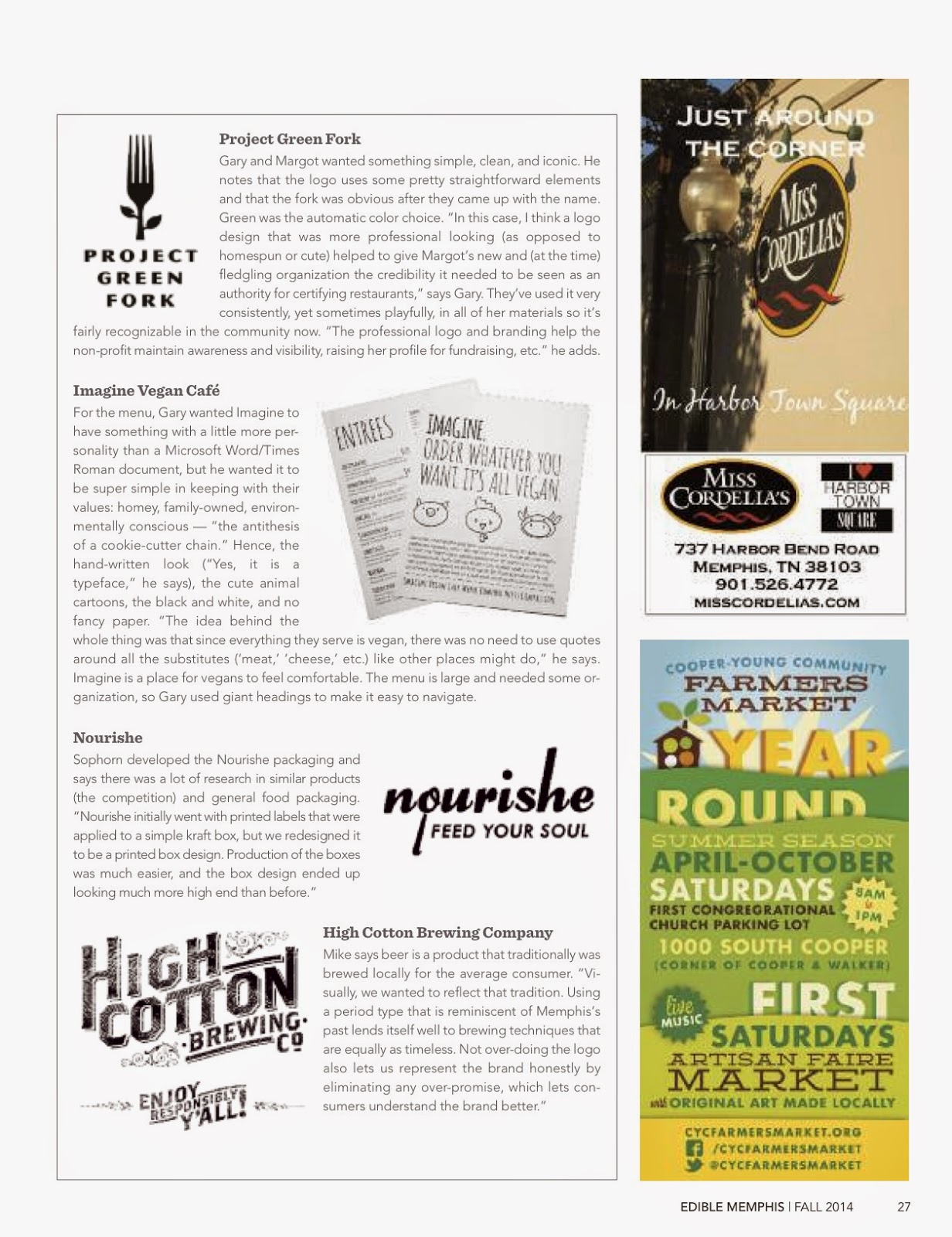
Standing out on the Shelf

Published in Edible Memphis, Fall 2014

Tuesday, July 1, 2014

Sippin Around Town

Published in Edible Memphis, Summer 2014

Celebrating Burgers

Published in Edible Memphis, Summer 2014

Tuesday, April 1, 2014

Navigating the International Stores

Published in Edible Memphis, Spring 2014

Cook like a Rock Star

Published in Edible Memphis, Spring 2014

Wednesday, January 1, 2014

Taylor Berger

Published in Edible Memphis, Winter 2014

Related Posts Plugin for WordPress, Blogger...